
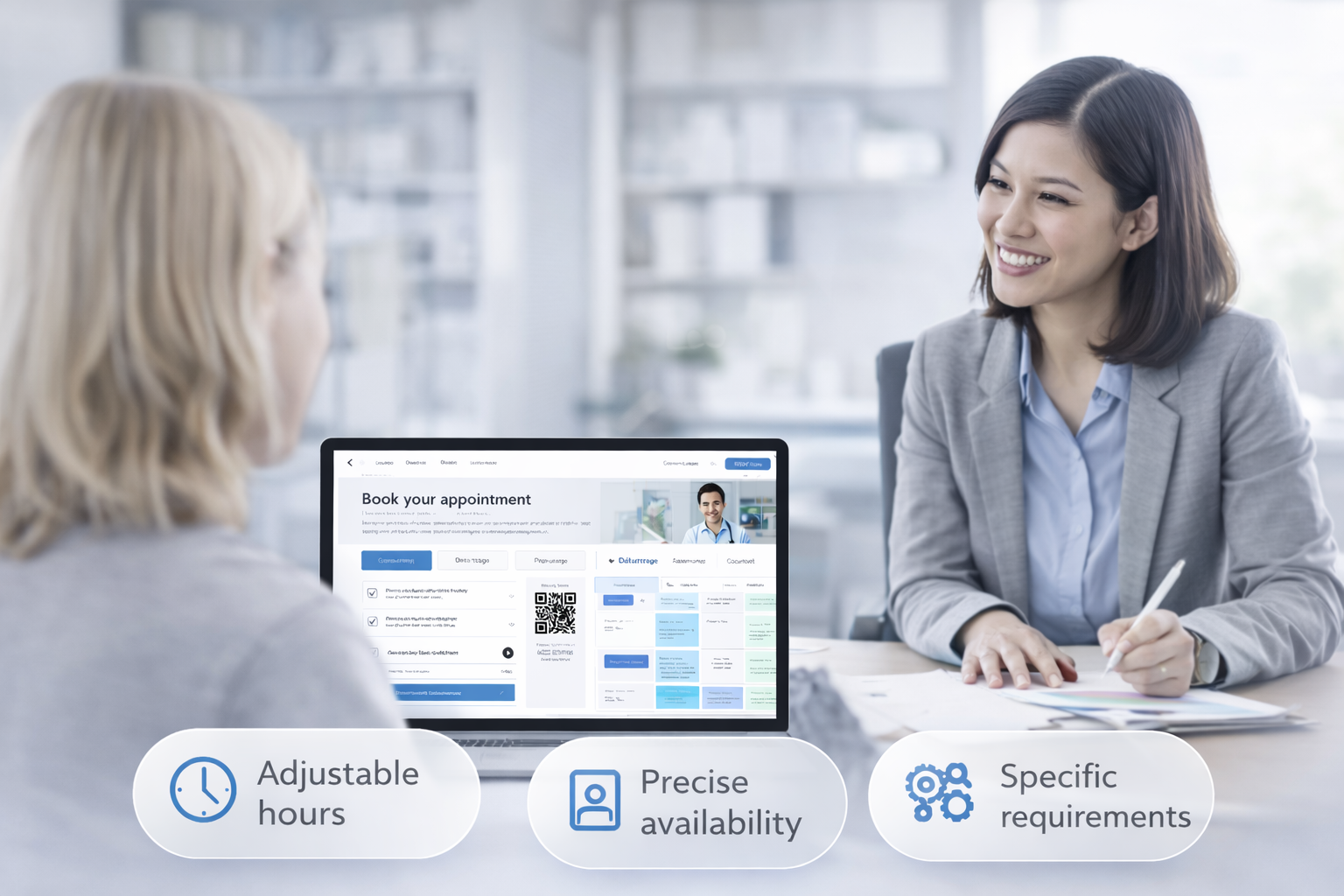
Every appointment-based business needs software that adapts to how it actually operates
As soon as a business runs on appointments, its efficiency depends directly on the quality of its organization. Without a clear system, calls pile up, back-and-forth messages take time, last-minute changes create confusion, and the team ends up handling too much manual coordination. Booking software brings order to that workflow by centralizing requests, schedules, availability, and services in one place.
More importantly, good booking software should not impose a rigid structure. It should adapt to the way the business actually operates. Every business has its own logic: different service durations, different schedules depending on the day, team-specific availability, breaks, limited capacity, internal rules, or its own way of organizing appointments. The right tool is the one that adjusts to that reality instead of forcing the business to change the way it works just to fit into poorly designed software.
That ability to adapt changes daily operations in a real way. The business keeps a clear view of what is booked, what remains available, how long each service takes, and how the day should be structured. It helps prevent double bookings, scheduling errors, internal oversights, and last-minute adjustments made under pressure. For a service business, booking software is not just an extra tool. It is an operational foundation that should support the real business structure with precision, stability, and consistency.
Booking software reduces no-shows, simplifies access to appointments, and strengthens the client experience
When a client has to call, wait for an answer, or exchange several messages before getting an appointment, the experience loses momentum from the start. Booking software makes access easier. The client can book through a direct link, a website button, or a QR code, depending on how the business wants to offer access. They can see the services, choose a time slot, and move forward faster. That simplicity makes booking feel more direct, more reassuring, and more aligned with current expectations.
But that experience only works well when the software reflects the internal reality of the business. A system that ignores real operating constraints eventually creates as many problems as it claims to solve. On the other hand, booking software designed to adapt to services, staff, availability, and operating rules helps build a smoother client experience on the outside and a more stable operation on the inside.
The other major issue is missed appointments and forgotten bookings. A missed appointment means lost time, an empty time slot, and a weaker schedule. With automated email or SMS reminders, the business supports a more stable calendar and reduces avoidable no-shows. It can also improve client follow-up, maintain better continuity, and strengthen its overall workflow. For any business that works by appointment, booking software becomes a practical tool to structure operations, adapt to the way the business runs, and deliver a more professional image.